120 E Grand Avenue #8 New Mexico 88101
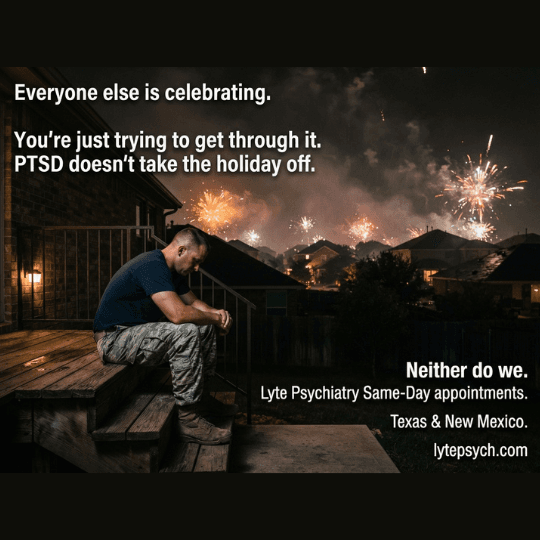
4th of July and PTSD: How Veterans Can Prepare for Fireworks Season at Lyte Psychiatry (Best Adults and Adolescents therapist & Psychiatrist Near You)
Fri Jul 03 2026
4th of July and PTSD: How Veterans Can Prepare for Fireworks Season
At Lyte Psychiatry (Best Adults and Adolescents therapist & Psychiatrist Near You)
By Lyte Psychiatry Clinical Team· July 3, 2026· 9 min read
What Fireworks Actually Do to a Veteran with PTSD and Why "Just Relax" Is Medically Wrong
The people who say "they're just fireworks" aren't cruel. They just don't understand what PTSD does to the architecture of the brain. This isn't about being sensitive. It's about a nervous system that was rewired by training and combat to keep you alive and that's now doing its job in the wrong context.
Your Brain Can't Tell the Difference Between Then and Now
When a mortar round hits 30 meters from you, your brain does something remarkable: it encodes every sensory detail the crack, the flash, the pressure wave, the smell of propellant, the ringing in your ears as a survival-critical memory. It burns it in. That's a feature, not a bug. That memory is why you survived.
The problem is that fireworks check every single box. The boom. The flash. The crowd noise. The smoke smell. Your amygdala the brain's threat-detection system doesn't have time for a philosophical debate about whether this is a mortar or a Roman candle.
This is called a trauma reminder response, and it's physiologically identical to the original threat response. The VA's National Center for PTSD describes it precisely: the sights, sounds, odor, and even the crowd reactions at fireworks displays can all function as sensory triggers that pull a veteran back into the emotional reality of combat not as a memory, but as a felt experience happening right now.
The Numbers Behind the Silence: How Many Texas Veterans Are Carrying This Alone
30%of Texas veterans surveyed in 2022 had been diagnosed with PTSD. But only 45% of them had gotten any mental health treatment in the year prior. That's more than half of diagnosed veterans going without care.
Texas has one of the largest veteran populations in the country. And a significant treatment gap exists not because veterans don't want help, but because the path to help is unclear, the stigma is real, and most civilian psychiatric providers don't know how to talk to someone who's been downrange.
For Iraq and Afghanistan veterans specifically, nearly 1 in 5 screen positive for probable PTSD. That means on any given street in Dallas, Corpus Christi, El Paso, or Albuquerque, there's almost certainly a neighbor who spends the Fourth of July the same way you do counting down the hours until it's over.
The instinct of many veterans is to avoid the holiday altogether seeking refuge in remote campsites, only to find that even there they weren't safe from the noise.
Avoidance feels like the rational solution. It is not. According to VA clinical psychologists, avoidance provides short-term relief but worsens PTSD symptoms over time because every time you flee a trigger, you're reinforcing the message that the trigger is genuinely dangerous. You're training your brain to be more afraid, not less.
A Real Plan for Fireworks Season and What Happens After You Survive This One
There's a difference between coping strategies that get you through the next 72 hours and treatment that changes the next 10 years. You need both and they're not the same thing. Here's how to build your short-term plan, and why this July 4th might be the right moment to finally pursue the long one.
The Short Game: How to Actually Prepare for the Holiday
These aren't feel-good suggestions from someone who's never been in the situation. They're evidence-based techniques that VA clinicians use with veterans who are actively managing PTSD. Start the week before, not the day of.
1- Map the noise landscape in advance: Knowing when fireworks will happen reduces the startle response. Check your city's official display schedule. Text your neighbors about their plans. Anticipated triggers are significantly less destabilizing than unexpected ones predictability gives your nervous system something to regulate against.
2- Build a "now" script before you need it: When your amygdala fires, your prefrontal cortex the part that knows you're in Texas in 2026, not overseas goes partially offline. Write yourself a short, concrete sentence beforehand: "I am at [location]. It is July 4th. These are fireworks. I am safe." Read it from your phone when you need it. It sounds simple because it is and it works by re-engaging your rational brain in real time.
3- Lower your body temperature: Cold water on your face, a cold shower, an ice pack on your wrists or neck this is a physiological interrupt. It activates the dive reflex and forces a rapid heart rate reduction. VA clinical staff recommend it as one of the fastest ways to break a PTSD trigger response in the moment. It is not metaphorical. It works on your nervous system directly.
4- Plan a meaningful activity, not just a hiding place: There's a difference between isolating (which tends to spiral) and intentionally structuring your day around something that absorbs you. A long drive, a workout you saved for that day, a movie you've been sitting on, cooking something that requires real attention. Give your nervous system a job.
5- Tell one person your plan: Not to be dramatic. Not to make it a big thing. Just so someone knows where you are and can check in. Isolation during a PTSD spike is where things get dangerous. One person who knows your plan changes that math.
Why This July Is Different If You're Ready for It to Be
Something has changed in veteran mental health access over the last two years. The cultural stigma is beginning to crack not because veterans suddenly got softer, but because enough people with combat records have said out loud that they got help and it worked. The Marine who "took a bad turn" when he got out and is now managing. The Army vet who relocated to the mountains every Fourth and is now sleeping through it.
PTSD is treatable. Therapies like Prolonged Exposure (PE) and Cognitive Processing Therapy (CPT) have strong clinical evidence behind them. Medication often in combination with therapy can reduce the physiological hyperarousal that makes triggers so destabilizing. The goal isn't to forget what happened. It's to stop being ambushed by it.
The biggest barrier for most veterans isn't access. It's the first appointment. Specifically, the fear that walking through that door means admitting something is wrong with you. It doesn't. It means something happened to you, and you're finally deciding to deal with it on your own terms.
Psychiatry not just therapy matters here because PTSD has a biological component. Sleep disruption, hypervigilance, and the startle response aren't character traits. They're neurological patterns that respond to the right medication protocols. A psychiatrist can assess what's happening across the full picture: trauma history, current symptom burden, sleep, mood, and whether medication is part of the right approach for you.
At Lyte Psychiatry, most new patients are seen within one to two business days, in person at our Pantego clinic near Arlington or by telehealth anywhere in Texas and New Mexico. We take most major insurance and most patients pay between $0 and $30 a visit. Call 469-733-0848 or book an appointment online.
In crisis right now? Call or text 988 (Suicide & Crisis Lifeline). Veterans: 988, then press 1, or text 838255. Or text HOME to 741741 to reach the Crisis Text Line.
Frequently Asked Questions:
Q: Why do fireworks trigger PTSD in veterans?
A: Fireworks replicate several of the exact sensory inputs loud concussive booms, bright flashes, smoke, crowd noise that the brain associates with combat. During a traumatic event, the amygdala encodes every sensory detail as a survival-critical memory. Later, when those same sensory inputs occur in a safe context, the amygdala can't distinguish "celebration" from "threat" fast enough.
Q: How common is PTSD from fireworks triggers in veterans?
A: Very common. The VA's National Center for PTSD estimates that 7% of all veterans will meet diagnostic criteria for PTSD at some point in their lives. Among veterans who served in Iraq and Afghanistan, that number climbs to nearly 20%. In Texas specifically, a 2022 survey found 30% of veterans had been diagnosed with PTSD and fewer than half had received any treatment in the prior year.
Q: Is PTSD from combat actually treatable, or is it something veterans just manage forever?
A: PTSD is genuinely treatable not just manageable. Two therapies have the strongest evidence base: Prolonged Exposure (PE) and Cognitive Processing Therapy (CPT). Both are structured, time-limited, and have helped large numbers of combat veterans reduce symptoms significantly or achieve full remission. Medication can also play an important role, particularly for sleep disruption and hyperarousal. A psychiatrist can assess the full picture trauma history, current symptom burden, and any co-occurring conditions and help determine whether medication, therapy, or a combination is right for you.
Q: Do I need a PTSD diagnosis before I can see a psychiatrist?
A: No. You don't need a diagnosis, a referral, or a clear explanation of what's wrong before booking an appointment. The psychiatrist's job is to help you figure that out together. If you've noticed that something feels off disrupted sleep, a short fuse, anxiety around loud noises, avoidance of social situations that's enough reason to make an appointment. Lyte Psychiatry offers same-Day telehealth appointments in Texas and New Mexico.